Theorizing Hypermodernity and the Politics of Belief (Pt. 1)

The primary thesis that HPB builds off of is Kristeva’s deconstructive discovery that the core philosophical distinction of subject and object is incomplete without a displaced (and thus destabilizing) third term: the abject. In Kristeva’s terms, the abject can be described as that which must be violently dispelled to form and maintain the subject and which yet remains frighteningly close to the subject, a repressed, segregated aspect of its identity that threatens to tear it apart and must be continually rejected. For instance, examples include bodily fluids (shit, blood, piss, vomit), corpses, venereal diseases, and psychotic madness. As the rejected part of psychosomatic experience, the abject can be understood as the Other living within, even when, like bodily fluids or a cured virus, it has already been expelled by the flesh or mind. In essence, the abject is the repressed excess which fractures and destabilizes any objectifying identity category, that disrupts normativity, that ruptures and breaks the image that claims to be an essence, that is in and of itself the broken image of an essence that can never be fully represented, the denied emptiness in any right to claim the soul of the Other, the emptying capacity of the image and its shackles, that emptiness that speaks in the image, the lack which exudes its own excess, the dark precursor that disestablishes order and leads to either collapse or creation. More simply, as Kristeva says, the abject functions as the ultimate disturbance to “identity, system, order. . .borders, positions, [and] rules.” It is ultimately the autotransgressive force underlying, and thus capable of either destroying or deconstructing, any belief about self, other, or the world.

By combining Kristeva’s insights on the abject, powerfully articulated in her 1980 work The Powers of Horror: An Essay on Abjection, with the more post-Lacanian and Nietzscheo-Marxist insights of Deleuze and Guattari in their Capitalism and Schizophrenia series, I work to show how the abject is not merely a psychological phenomenon whose encounter links us to the Real, but can in fact be a productive counter-deterritorializing force allowing us to confront hypermodern capitalist accelerationism. In this case, I examine how the abject functions as a part of transsubjective identity that cannot be objectified, cannot be made into a stable, consistent model image or form for codification, making it outside of the realm of possible commodification. By exploring, surveying, and mining the abject, we participate in a deconstructive and deterritorializing process that I refer to as abjectivity in contradistinction to subjectivity and objectivity. Abjectivity operates somewhere between the subjective and objective, between the self and other, the imaginary and the real, the surreal and infrareal, something that is not fully falsifiable and yet elicits fascination, a kind of horror and a kind of joy that makes us believe in it at the same time that it makes us question the beliefs that allows us to normally function as stable egos in ourselves and in the world. It is this transgressive potential — a potential which may be (cautiously) approached and potentially influenced through psychosomatic investment, but is essentially autonomous — that makes it potentially a radicalizing, transformative, and still yet frighteningly destructive force.

As Nietzsche already noted, a force in the individual or collective psyche always produces a dominant affective response, and the type of affect that emerges in relation to that force determines the general direction, form, and viability of that psychosomatic body in regards to its environment. I argue that there are two underlying affects (and affective economies) that have dominated the human psyche: the oceanic and the apocalyptic. The oceanic, which is considered a mythic case and thus part of the imaginary, is the fantasy of a complex general economy in which the split between self and other is either absent or at least experienced in another way through a porous ego; the other affect, on the other hand, is the apocalyptic reality of the conscious/unconscious/self/other split, the mode of being which allows for discrete identity and thus separation and repression. The first affect, the oceanic, is a myth in the sense that it is a story about pre- and the possibility of post-egoic consciousness (Wilber’s pre and trans fallacy is pertinent here), whereas the apocalyptic affect is the natural refutation of that myth. In other words, the oceanic represents the myth of uninterrupted wholeness (was Man ever truly one with with the (M)other?) and the apocalyptic manifests as the divisionary egoism that splits that wholeness into hierarchical relations (O, how Man excepts himself!). The apocalyptic dismemberment of the body of the oceanic is the process of exaltation and abjection (O, how Marduk tears apart the limbs of Tiamat to craft his world!); the abject is the refuse, the expelled remains of all that is outside the ritual commodities such as idol, essence, archetype, figurehead, and territory. It is these ritual commodities that create the fantasy of the striated universe and thus allow for the conscious mind to participate in the oikos (eco-system, eco-nomy) of capitalist, religious, and social common sense.

Ultimately, the apocalyptic logic of capital is that everything can be de- and re-territorialized into ideological capital, and the excess which escapes capture in the moment can be repressed until shifting faultlines allow/demand further recapture. The notion of the primitive accumulation of belief refers to the ways in which capital has always-already seized control of the possibility of any given future belief before it can emerge. By ordering each thing as an object of utility (idol), value (essence), meaning (archetype), need (figurehead/salesman), and purpose (territory), capitalism separates its own products from any “original” that could exist — the mythic referent, the signifying signified from the untouched past, the presubjective Other that lays the foundation, maintains the origin, and justifies the chain of identity — the simulacra of which proliferate as so many partial objects which may be essentialized by new figureheads and archetypicalized as the new reality. A slow, aberrant deterritorialization in which “essence has been razed” (“They Come in Gold”, Shabazz Palaces) and yet continually haunts the order of things, ala Blake’s “The Ghost of a Flea”. The issue here is not that capitalism extracts the new for profit or control, but rather that its objectifying/commodifying/essentializing habit of representation is selling ourselves back to us before we can truly assess who we are, where we are going, or where we come from — at times wondering if from anywhere at all…

Again, the problem arises not in that capitalism is capturing every last element of our difference and selling it back to us, per se, but that it is extracting our self-extractions and selling them back to us at such a rate that in the face of being sold the same fantasy — that our differences are compartmentalized into clean categories of self and other, ego and group, us and them — the actual traumas of our colliding primordial and accumulated differences are under the pressure of exploding as potential psychopolitical volcanic faultlines. Thus the categories of species, race, gender, ability, religion, and politics are so many essentialized ritual commodities that we trade within the factories of ideological capital in order to separate and congregate, but the splits between each other and within ourselves speak to the underlying fact that these categories are artificial at best, and explosive at worst. At the same time that they allow the possibility of collective referent, they constrict and agitate; again and again, they fall short and spark and spit and shatter from the friction of an invisible force, the repressed abjectivity of infinite difference. To deny the material reality or pragmatic necessity of these categories is not the goal; it is rather to deny their stability, and thus honor their inherent aberrance. The more the accelerationist fantasy pushes us to identify these categories, and thus exchange and compete for our own forms of their interpretation (e.g. will my vision of the essence of trans-ness as existential mutational openness, and the archetype of the organic transsexual, gain traction in the marketplace of ideas, beliefs, and existential intentionality/action?), the more our ritual commodities battle in the arena of apocalyptic affect. This hypermodernization forces the received real to confront the perceived possible.

At the same time, both products are shipped back to us in a convoluted form, an attempt to market the essence of selfhood in the form of competing ideologies of humanism and posthumanism, the common and the elite, the traditional and the futuristic; all of which we wrap ourselves in whatever combination suits are chosen ideological and aesthetic configuration. The present itself becomes an arena in which everything that’s ever been believed and ever could be believed must struggle for supremacy. So how do you greet this apocalypse — aka the desired end of this combat, this agony, that never comes, for good or for ill? With laughter or screams? Joy or sorrow? Affirmation or nihilism? While the battle over essence and antiessentialism wage on, it becomes possible to either withdraw from the project of confrontation or become so obsessed by it that one essentially loses track of the plot. The withdrawal into voyeurism — just enjoying the collision of difference with ideology — is the passive cousin of the terrorist’s hypervigilance. Either way, the danger is that we isolate into the underinvestment of entertainment or the overinvestment of terroristic paranoia. The problem is neither the voyeur nor the terrorist has any future to believe in — only a flooded present and a mythical past. Flooded by images or flooded by immigrants; either way the fantasy continues. Thus capitalism’s ability to sell us what we want fuels both impotence and reaction.

Conclusion: The point now is not to succumb to either form of nihilism, passive (the voyeur) or active (the terrorist), but rather to mine the contradictions that emerge between the received and the perceived, expressing modes of thought from the future that extrapolate the past, history and myth, and transform our relationship to the present; in other words, the job of the schizo is to follow lines of flight into the possible and back again, to immanentize future politics. Futurism, in this sense, is the confrontation with the eerie, weird, surreal, and infrareal space of hauntology, hyperstition, death, fantasy, nonsense, chaos, and the impossible.
Hypermodernity and the Politics of Belief: A Schizorealist Theology

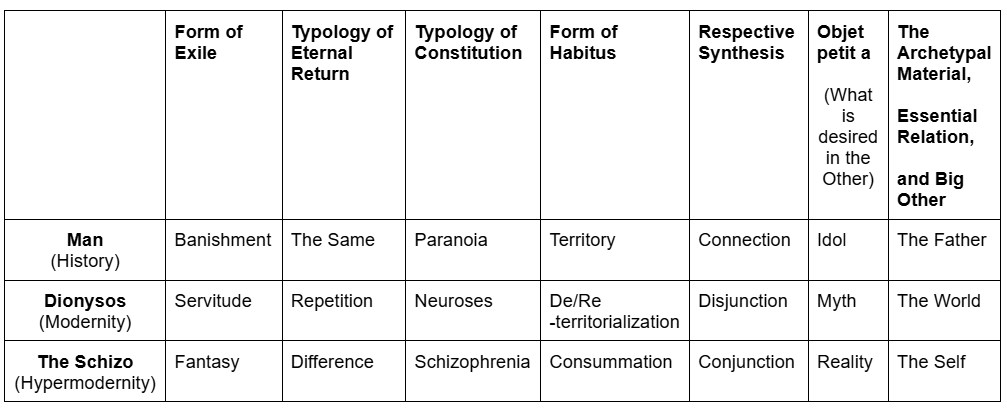
The thesis of this work is that the unconscious is a vast network of beliefs about the nature of self, others, reality, purpose, and desire. We inherit these beliefs as a part of our condition of belonging to the species, to our cultures, and to our milieu. Primarily, considering the subjects of philosophy, our viewpoints are partially given to us and partially constructed. While it may be easy to say that the conscious mind is where beliefs are constructed, Deleuze and Guattari would argue that the unconscious itself is a constructive apparatus filled with desiring-machines, which construct and deconstruct beliefs without annihilating them. In this sense, everything that has entered the unconscious or emerged from it is always in play, whether we disavow these beliefs consciously or not. As D&G note in AO, the unconscious operates primarily by three syllogisms: connective, disjunctive, and conjunctive. The unconscious is ultimately structured as partial objects that are ontologically indistinguishable — in other words, according to the unconscious there is initially no meaningful difference between the ontological status of chairs, unicorns, numbers, the alphabet, hopelessness, time travel, and death. It is only through the unconscious proposition of opposition — the disjunctive synthesis — that these partial objects begin to be categorized into a formal ‘yes’ and ‘no’, an either/or, habit and taboo. Essentially, the subject is the conjunction of these two fields, these yesses and these nos, the vast majority of which are unconscious. The conscious mind, ultimately then, is the repository of these judgments of God (this fundamental architectonics of the unconscious) and the space at which point one chooses their ethics (in other words, their yesses and their nos). The skeptic (philosophical), the nihilist (political), the hedonist (ethical), antinatalist (metaphysical), and the atheist (theological) are all conceptual personae who serve the question, doubting cherished beliefs and interrogating idols, conscious and unconscious. Ultimately, they are the hammers and dynamite which allow the yesses and nos of consensus reality to themselves be disconjoined; that, in other words, shatter the habitual habitus of Man and break taboos — a disjunction of the disjunction, a split between traditional ways and progressive experiments. This process — carried forth by the warmachine of technoscientific capitalism — is what Nietzsche means by the death of God. 

Essentially, the death of God is the process of taboos (which essentially are the Divine ‘no’, the profane) being transformed into open possibilities and active choices by cultures in transition, i.e. deterritorialization (the shattering of idols) and reterritorialization (the establishment of new ones), whereas the territory is the bounds by which accepted living (the habitual habitus) and the taboo are cleanly separated, a segregated collection of connected ‘ands’ that do not commingle with their opposites. It is this active process of the death of God, the razing of idolistic ‘yesses’ and the reconsideration of the ‘nos’, that both frees desire and allows new configurations of worldviews and lifestyles to emerge. The problem, however, is that this does not prevent pathological, precarious, and prereflective configurations of desire from being absorbed by the automachinic fantasy machine that is capitalism. Whether it be white suburban teens buying Che Guevara t-shirts at the mall in 2006 or Cuban immigrants buying MAGA hats in 2025, there is a tendency for capitalism to provide the fantasy that fills the gap left by its own iconoclastic, deterritorializing tendencies. Humans in the consumerist stronghold of the first world are able to embrace the magical idealism of this fantasy — imagining themselves as revolutionaries for $30 regardless of party — allowing them to participate in a collective and personal reconstruction of their identities and belief systems. The white kid transgressing capitalism with her Che shirt or the Cuban immigrant transgressing communism with his MAGA hat are fulfilling the same habit — the duty to break the taboo, to be iconoclastic, to be radical, whether we call it revolutionary or reactionary. Capitalism needs this type of iconoclasm of values because it creates a discontinuity between the past and present, a breaking of habitus that allows new habits — in fact, addictions — to be constructed and harnessed. The ultimate goal of capitalism is not to annihilate ideology; rather, capitalism needs competing ideologies to justify the inherently neutral status of consumerism, and ideologies that are consistently bolstering and weakening each other creates the perfect conditioning for apathetic acceptance of the daily life of capital. This multipolar battle between ideologies old and new is the ultimate place for the schizoid consciousness of the consumer to continually affirm or deny, and thus reinvent, themselves. Action, reaction, and apathy become the Trinity of a system that is essentially always undermining our ability to believe in the world while also giving us a thousand causes, products, and celebrities to believe in. The warmachine of accelerationist fantasy is a line of flight that disrupts all foundations, a hypermodernizing process possessed by a death drive of infinite accumulation, a swarm of market machines feeding off of (and producing) the desires of the consumer classes. At the same time that it constantly provides new sources of pleasure and means of satisfaction, it deconstructs, scrambles, and rearticulates the belief systems of the past so rapidly that they become disarticulated and reentangled within the accelerationist Zeitgeist, becoming accouterments of a vast web of identity systems. As humanity launches themselves into Hypermodernity, the notion of belief, identity, and aspiration have become both the contested battleground of the future and the site of the inoculation of threats. The question is, are we cruising within the accelerationist fantasy — the belief that a pyramid scheme of greed can save us from past sins against the Earth, its other inhabitants, and ourselves and lead us to salvation — or are we finding ways to survive its inevitable (?) collapse?

In the midst of this groundless becoming, we are forced to confront the death of God/Being through construction of mythic unities — in other words, metaphysical belief systems that comfort our neuroses and allow us to satisfy our desire for wholeness. Ultimately, as the human experience is continually driven by the power of capital’s self-accumulating ability to accelerate, subsume, and transform our world and our psyches, it becomes increasingly obvious that the splitting of wholeness, experienced as lack, desire, need, and eventually addiction, is the painful, perpetually wounding vehicle by which capital mobilizes humanity. This underlying negativity is the schizophrenizing impulse that makes each new experience of wholeness but a momentary glimpse of relief, with achievement, consumption, accumulation, and legacy being the prized means by which we find our sense of self. This self, like an oil deposit, is a continuously fractured site for energy extraction and commodification. While the experience of pleasure is real, even to the point of satisfaction with one’s life and genuine happiness, this happiness is the mere flipside of the terror, abjection, and torture of lives lived outside the bounds of capitalist (in)sanity. In other words, desire feeds the capitalist fantasy whether it be the desire to survive that forces the undercommons to work menial, unfulfilling, but necessary jobs or the desire to dominate that motivates the success stories of “capitalist excellence” which reify precarity as bad luck, poor discipline, lower intelligence, and criminality. As the collective capitalist fantasy continually takes hold, notions of identity and purpose become increasingly tied to it; and at the same time, fantasy and pleasure becomes the dominant means by which the undercommons evades our new reality and grand narrative of capitalist nihilism. To escape from capital, the human being learns to dream, looking inward toward a world of schizophrenic flows that could result in catatonia (no mythic unity), paranoia (a reactionary separatist unity), or, if we are lucky, revolution (a mythic unity that continuously gathers all inward, ala religion, and outward, ala politics). The key difference between the three is that the first result is personal, the second collective, and the third metaphysical. It is only via the third route that humanity will actually be able to confront the death of God properly (the irrational delirium of groundless becoming), and thus be able to ascertain the true meaning of politics and religion: rational myth in process.

In other words, politics and religion are continuing rational myths — believable stories — about why life matters and what matters in life in the midst of change, chaos, and ceaseless and accelerating transformation. These myths provide us shelter — habitus — by carving out slices of chaos and constructing an overarching narrative that provides rationale for participation in collective life. Sylvia Wynter describes how these myths perpetuate and transition while maintaining a basic tripartite structure — from the Christian-Self, Creation, and God of Man1 to the Ego, Id, and Superego-Capital of Man2, we continuously find the respective Subject, Abject, and Object. The Subject is ultimately reliant on and overwhelmed by the Abject, which is the Outside found within, which the Object feeds upon to vitalize and fuel its mechanisms. Ultimately, the Object is the incorporeal become Flesh, the result of a hyperstitional Platonism: the (white, colonial, modern) Subject tracing and constructing itself through its myths of the Abject, a self-proclaimed Übermensch pushing a Sisyphean Object, its Abject-extracted Other, higher and higher each time, until, reaching the pinnacle ala Zarathustra, returns back to their cave and sends the Object flying furiously down the hill. This Zarathustra, this Man above Men who turned the highest thought of unity into the highest force of multiplicity, this dynamite, this idol shatterer — he says that God is dead and we have killed him. What is left is the force of Man’s belief come tumbling back upon them, shattering us and it into trillions of shards. Is there any way — is there any reason? — to rebuild the Unity of the Object? Or is the Object merely destined to float, melt, and congeal along the flows of Abject desire, all while the Antichrist laughs atop his mountain? Has the death of God not resulted in the lowest things become highest, and was the mountain that stands towering above us — the sign of our slavery to a nihilistic process in which capital has become our god — not once a pit and a cavern? Did not the whole world twist and turn when humanity declared money their god, selling their abjectivity — their desire, their very mind and soul and ability to imagine — to a devilish craftsmen of endless spectacle and fantasy? Is this not the very consequence of desiring God and in the end finding desire to be more appealing, more useful? Have we not, inadvertently, constructed ourselves a tangible, measurable, and observable god — the Spirit of limitless desire in the flesh — our inescapable lord of the earth and prince of this world, Capital?

If the double-bind theory is correct, then schizophrenia is a condition that emerges from repressed and contradictory beliefs/myths/territories or habits of psychic emodiment. The experience of schizophrenic psychosis is ultimately the semiautonomous irruption of these contradictory beliefs, oftentimes at the behest of personal crisis, into a precarious and vulnerable conscious psyche. The quotes “. . .the ideology of capitalism [is] ‘a motley painting of everything that’s ever been believed’” (AO, p. 34, quoting Marx) and “Our society produces schizos the same way it produces Prell shampoo or Ford cars, the only difference being that the schizos are not salable” (AO, p. 245) go hand-in-hand. The schizo is the residuum of the capitalist process, an unconscious that is an exploding Pandora’s jar of autoreterritorializing fragments of past, present, and future — time and space local and distant, personal and collective, experienced and imagined — a sort of canary in the coalmine of unsuccessful hypermodernization and secularity. What the schizo reveals ultimately is the vacuum of disbelief at the heart of the warmachine of capitalist acceleration/hypermodernization: replacing belief-habit (affirmation, territory) with fantasy-addiction (negation, de/re-territorializaton), hypermodernization ultimately results in a world not driven by conscious action and decision, but by unconscious drives and fantasies. The fantasy, unlike the belief, is happy to be a mere simulacrum of potential reality, a forestalled hyperstition that motivates the subject like a carrot on a stick.

 “One day, I will have enough, if I just keep going through the suffering, working, accumulating.” The fantasy of total satisfaction. “One day, it will all make sense, but let me not think too hard on it, it will come with time.” The fantasy of pre-existent and predestined meaning. “One day, I will be free and so will all others if history just takes its course.” The fantasy of predestined liberation. True belief, on the other hand, motivates a parallel activity: I will never be totally satisfied, so I maintain a sober mind. I will never make sense of the world and myself if I do not study, reflect, and think creatively, so I labor toward each of these things. Liberation will never occur without collective effort, so if I believe this to be so, I must act towards this end. Essentially, beliefs are habitual thoughts that we concretize and actualize through habitual action, forming a habitus or a territory. Fantasy, on the other hand, is a process of chasing after a habitus or desiring to reach one that one cannot reach due to either faulty means or because the end is impossible. In other words, the fantasy is a transcendent, otherworldly hope — total satisfaction, preestablished meaning, predestined liberation — motivated by the addictive cycle of chase and resignation. Belief, on the other hand, is an immanent activity, a steadfast repetition that establishes reality in and through its encounter with difference. While fantasy-addiction commodifies, objectifies, and consumes difference, believing as an immanent and lasting practice engages, dialogues with, and is transformed by it. A belief that is untested and unaffected by the world is a lesser thing, a mere fantasy; a belief that rises to the occasion of being tested, again and again, learning and growing and risking itself to know itself, is what we would call a living faith. While fantasy causes resignation from ultimate concern, whether it be sanity or liberation, faith demands commitment and can only, like Deleuze’s swimmer, be found in the risk-taking dice roll of continual encounters with chance (repetition) and its result (difference). The beliefs that emerge from these encounters with immanence are the beliefs capable of Life, and thus capable of outliving capitalism’s death drive. Just as the Knight battles Death in a game of chess in Ingmar Bergman’s The Seventh Seal, it will continually be the beliefs that have and will have risen to the status of faiths that will confront capitalist fantasy, and it will be the repetitious actions of anti-capitalist/socialist faith which will testify to capitalist ruin.

Capitalist ideology — the religion of capital and commodity worship — is inherently a schizophrenic swarm of objects, flows, means of production, and desire/desiring-production — the same basis for which exists all forms of belief. For instance, in any religious belief system we have the object of belief (God/the Sacred/the Idol), the flow of belief (prayer, fasting, tithing, icon-making, pilgrimage), the means of production of belief (churches, temples, the sacred text, etc.), and the desire of belief (the will-to-believe in the subject and congregation). Capitalism ultimately captures this structure and redirects it toward its primary object — capital and its commodities — transforming prayer into labor, churches into factories, and thus redirecting desire toward a divided God: the ever-exchanging cycle of capital and commodities. This bifurcation at the heart of the capitalist system is what differentiates it from the system of monotheistic belief. Whereas the ideal believer in a united object of belief such as God submits their body, mind, and spirit to one object — a storing of their treasures in heaven — the subject of capitalism is in an everlong battle between accumulating capital and accumulating commodities, the accumulation of the one which depletes the other (a house divided against itself cannot stand). This creates an everfluctuating economy of loss and gain, which replaces the ethical yes and no, the epistemological true and false, and the moral virtue and vice. The bipolar god of capitalist consumerism thus contains negativity at heart of its positivity: at the point that there is a gain in capital or commodity, there is a loss in its other half, though each is a desired object, part of the same body of flows of desire. There is no pursuit of capital without the desire for the accumulation of commodities, and no accumulation of commodities without the necessary pursuit of capital. The body, mind, and spirit of this system is thus in service to two simultaneously complementary and contradictory objects, unlike the ethical, epistemological, and moral bifurcations expressed earlier which require decisiveness. Therefore, capitalism is inherently bipolar and doubleminded, endlessly serving two masters without sincere ethical, epistemological, and moral concern. In this sense, capitalism creates subjects that are simultaneously lukewarm and zealous; zealous in their pursuits, lukewarm in their concerns. We must therefore conclude that capitalist duotheism secretes nihilism — a disavowal of decisive (and thus lasting) stances on knowledge and facts, morality and law, and decisions themselves. This allows capitalism to simultaneously absorb ‘the motley painting of everything that’s been believed’ without truly believing in any of it. Capitalism, ultimately, is the ideology of unbelief in consistent ethics, committed stances, decisive morality, and inherent value of anything other than itself, including the very world that sustains it. In other words, capitalism is the religion of perpetual disbelief — “the truth is, we haven’t seen anything yet” (p. 240). Whereas Mark Seems celebrates “a radical politics of desire freed from all beliefs” in his introduction to the English edition to Anti-Oedipus, I argue that to believe is to choose to believe, and to not choose, and thus to not believe, is still a choice. The men who believe in nothing are not the liberated schizos, the orphans, atheists, and nomads of “anti-oedipal forces”: they are, rather, “AntiChrist[s], [the so-called] antinihilist[s]” (AO, p. xxiiivand On the Genealogy of Morals, Section II, Aphorism 26). If the antinihilist is the man who believes in nothing, then he is in fact serving the master he hates while claiming to serve the master he loves: this is the man of lawlessness, the capitalist cog, a dilletante in terms of the stakes of life and the meaning and necessity of belief to the project of liberation. Seem’s anti-nihilist is the subject of a vacated past, an empty core, and an open future where anything and everything is already justified by right of the fact that decisive judgment has already been invalidated due to its reliance on some kind of belief system, whether that system be philosophical, ethical, political, metaphysical, or theological. In this way, nihilism is the ideological unconscious of capitalist futurism, its pseudofuturism…

This is not to critique futurism in favor of some lost (and thus reactionary) archaicism, but instead to juxtapose the futurism of socialist hope — a deceleration that allows for the activation of abandoned hyperstitions, our hauntological futures — against the capitalist acceleration that debases our very ability to believe in anything at all but speed, accumulation, pleasure, hunger, destruction, annihilation, and the virtue of apathy. In this sense, we are juxtaposing a religion of love against a religion of death. Agapic socialism and fascistic capitalism, Christliness and lawlessness. Decision, then, is the first and final act, the everrecurring repetition and habit, that must win out over apathy: Today, we must continually say, I choose to have faith in the world, hope in the future, and love for the Earth and all its creatures!

Table depicting the relationship between three conceptual personae and various typological categories.