Blog

Non-Duality as a Vision, as (R)evolution:

It should be noted that, as one might recognize from IGF’s subtitle, non-duality is a key to understanding the material (evolution), political (revolution), and spiritual (vision) essence of the book. Foundational to the project of Western Modernity is a series of dualities: self/other, subject/object, mind/body, spirit/matter, male/female, Christian/pagan, settler/“savage”, West/East, North/South, capitalist/worker, progressive/reactionary, white/Black, etc. It is these dualisms that I target; though they may be helpful to conceptualize and map reality, they are inherently artificially reductionist. 

The excess of the Real, on the other hand, calls for something far more radical: a vision that is truly integral in a revolutionary and evolutionary way — hence the use of the term (r)evolution, which reflects the two primary tactics of anarchist praxis, revolution against the State and evolution of anarchist communities in preparation for a phase-shift into a State-less future. There is a key spiritual, Christocentric connection here in terms of an anticipation of eschatological arrival of the Kin-dom of God. Thus my (r)evolutionary vision is one which is both anarchistic and Christocentric, albeit with a Christocentrism that is esoteric and perhaps heretical. I’m in agreement with many esoteric thinkers, including Rudolf Steiner, that the Second Coming of the Christ is multiple — it is the awakening of the Christ-consciousness in each individual Self. This is the kernel of non-duality that leads to my political vision.

It is my firm commitment to the excess of the Real, represented by Deleuze in the equation “PLURALISM = MONISM”, that leads me to the dissolution of dualities and the union of opposites. This is not a naive dissolution and union, in which things are seen as essentially one-and-the-same; rather, it is a complex, integral dissolution and union in which each-and-every thing is differentiated, individuated, and caught up in a multiplicity of forces that spawn from an ontologically monistic primordial flux. As Deleuze writes in Difference & Repetition,

Opening is an essential feature of univocity. The nomadic distributions or crowned anarchies in the univocal stand opposed to the sedentary distribution of analogy. Only there does the cry resound: ‘Everything is equal!’ and ‘Everything returns!’. However, this ‘Everything is equal!’ and ‘Everything returns!’ can be said only at the point in which the extremity of difference is reached. A single and same voice for the whole thousand-voiced multiple, a single and same Ocean for all the drops, a single clamour of Being for all beings: on the condition that each being, each drop, and each voice has reached the state of excess – in other words, the difference which displaces and disguises them and, in turning upon the mobile cusp, causes them to return.

In this way, the differentiation of “all the drops” is the exceeding of the naive universalism that so often informs so-called mystics. What these individuals experience is in many ways true — that we are all part of “a single and same Ocean” — but what they miss is that individuation is a necessary, even desirable aspect of this “clamour of Being.” It is a “clamour” — a roaring infinitude, a commotion, a gathering, a multitude. The naivety of a non-dual universalism is the result of an impoverishment of thought and feeling, leading directly to the counter-movement of dualistic thinking. What is needed, then, is an overcoming of dualistic thinking through increasing attention to differentiation and singularity, the excess of the Real.

So “. . .the difference which displaces and disguises them and, in turning upon the mobile cusp, causes them to return” is the return of dissolution and union; however, this time it is complex, integral, and perspectival. Rather than saying that our singularity is in fact an illusion, we can say that we are individuated manifestations of the Real, embedded in our historical, social, and material contexts, enfleshed in a distinct body, and epistemologically unique. We are, in so many ways, not just shadows of the Christ as Christian orthodoxy would say, but instead singular incarnations of the Christ-consciousness. Our Self-consciousness is of the Universe, though it is not universal.

The obvious critique that could be laid against this concept of pluralism is that it itself seems to be making a universal claim on the nature of reality. This is the crux of “PLURALISM = MONISM”. There is much to be decided about what constitutes reality, but I make these claims not because I feel that they are inherently more true, per se, but rather because they are both more beautiful in my opinion and, I hope, more pragmatic. The issue arises because I am attempting to persuade; that my persuasion be ineffective is a chance that I take. The goal for me is not to prove my vision, but rather that my vision proves itself worthy of the excess of the Real. Beyond the naivety of universalism and the fabrications of duality lies the fabulation of the cosmic: that we are here to create the Universe, to spawn a New Story as Thomas Berry says, and to initiate an eschatological transformation of our reality and our selves. It is simply a wager I’m putting out into the world. If it doesn’t speak to you, let it pass; and if it does, craft with it your own vision of the (r)evolutionary path beyond tomorrow’s morning.

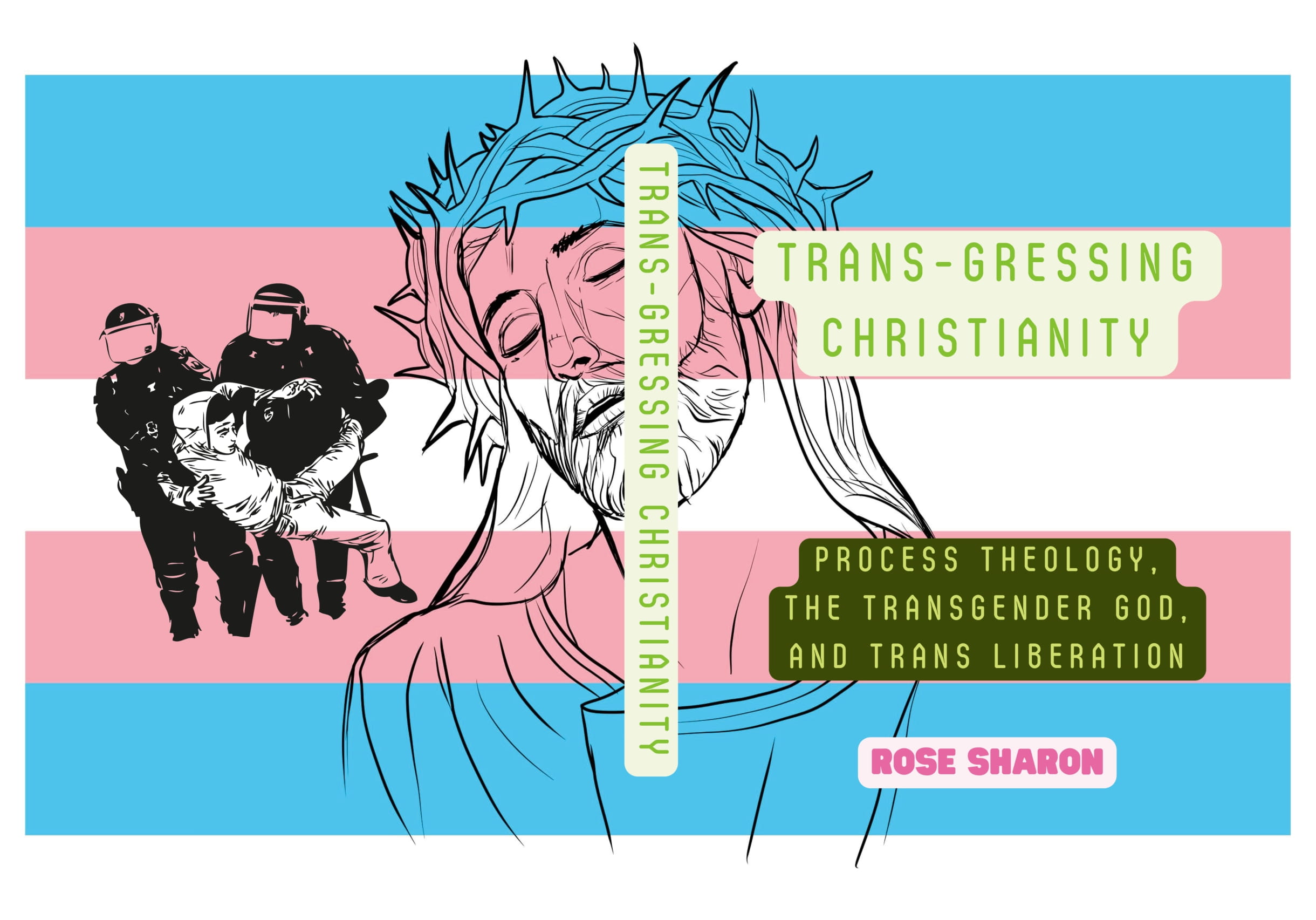
Trans-gressing Christianity

“Trans-gressing Christianity: Process Theology, the Transgender God, and Trans Liberation” is an essay I wrote as part of my application to Drew University’s Theological and Philosophical Studies in Religion PhD. This is a work I cherish deeply. The entire essay is included below, along with a cover for a potential physical version that I’m self-publishing to pass around amongst friends and family. I hope you enjoy, and may we trans-gress together!

A brief note on ‘sonic utopianism’: a concept to be explored in the section “Posthuman Phonosophy”

In all of complexity there is harmony and dissonance. Singularities emerge where difference, through the play of dissonance and harmony, creates, destroys, and transforms grooves. The reason that things appear teleological is because of the linear transition of time which we experience, but songs communicate across the whole grid, from before or after, across or through, simultaneous or distant, rhizomatic and thus studied schizoanalytically, all with each other and with the world(s) they are a part of. To write minor riffs, to jam, to freestyle, to drive the grooves into counter-grooves, to establish dissonance in order to create anew, to develop harmonies from what has been abandoned and what is yet to arrive. This is sonic utopianism.

Apokalypsis and Life (a (re)becoming-We beyond the Genocidal Paradigm)

NOTE: It’s been quite a while since I posted something. I’ve been struggling with a depressive episode and unemployment, and have found little time or energy to devote to the next section, “Capitalist Realism, Coloniality, and the Anthropocene”. It’s going to require a lot of work and will be a significantly longer post due to how essential each of these three subjects are to the project as a whole. I found new enthusiasm, however, in the past week or so: I decided I’m going to apply to Drew University’s Theology PhD program to hopefully study with Catherine Keller (a favorite scholar and theologian), who I met with briefly over Zoom recently; and, very happily, I discovered I was accepted into Rosi Braidotti’s course on “The Posthuman and New Materialism” which I will be participating in in August. To the point: I just started transcribing thoughts and came up with this post below. While it is not necessarily the subject of any specific section in IGF, it does have relevant ideas to the work as a whole, particularly in relationship to my reading of apocalypse (heavily influenced by both Keller and Braidotti), the relationship between politics and spirituality, the current paradigm shift, and (though not mentioned by name) Spinoza’s concept of Deus sive Natura (God or Nature). I hope you enjoy!

I’m on the verge of a breakthrough—a conclusion and a new beginning. I have been obsessed with the apocalypse for a very long time, such a miniscule amount of time when measured by the clicking second hand of the clock, such an infinitesimal pool of time when relativized and allowed to be a microcosm of eternity. That there are some infinities bigger than other eternities is not, at its most, a mere quantitative determination; rather, it is qualitative. An intensity of energy that is affective and felt, a magnanimity of contrasts and complexity. To feel in a broader way, to enter into union with the grandest and subtlest of sensations, to know the full breadth of the beginning and the end and yet to live engulfed in its infernal and cosmic procession—this is the infinite that I am speaking of, the unveiling of apokalypsis.  

Each life is an expression of this Life, this fullness of the unfurling, entwined and entwining, deepening universe. As creatures endowed with a life force, we can live in isolated cubicles of this cosmic dance, pressing keys and filling out paperwork, detached from the sheer audacity of a vibrant, rhythmic eternity. Under the watch of the clicking second hand, the domineering boss, the voice of a repressive mommy and daddy, we may lose the sense of childlike wonder that makes being fresh to Life—not just our life—so enthralling and creative. And in that lost sense, we may even—in fact, we most certainly do—diminish the intensity, passion, and beauty of our own life. The initiation of adulthood, particularly in a disenchanted, mechanistic, and capitalistic paradigm, is one which is either bent on violently destroying the intuitive and imaginative capacities of a fresh and childlike mind, or, perhaps even worse, commodifying and exploiting those capacities for the soulless and lifeless demands of the market. In the end, they serve the same purpose: to divorce our life from Life itself.

For the longest time, I have considered the apocalypse to not just be a future happening, a moment in historical time in which all people are synchronously forced to meet their Maker. Rather, I view apokalypsis as the unveiling of one’s life as an expression of Life—a microcosm of the infinite and thus a manifestation of infinity itself. Everyone who has lived a life will at some point confront this, not once and finally, but perpetually and in process. It is the relationship of the part to the whole, the many to the one, the vine to the branch. It is the confrontation and dialogue with death that inspires the vibrant living out of a lifelong communion with Life. It is the spirit of childlike wonder and sense of adventure that is so natural to the fresh mind, a mind ever in need of refreshment, continually requiring the wetting of the tongue and the rehydration of the body. That many children are robbed of this state of bliss through violence and trauma does not disprove its primordial truth; instead, it suggests the deep need to battle against these forces of traumatizing violence and to instate sources of healing and reconciliation for our hurt and damaged communities. This requires a confrontation not only with personal suffering, but collective, historical, geopolitical, planetary, and, ultimately, spiritual suffering. Apokalypsis is an initiation in and through these spheres of existential belonging—not the arrival of a messianic figure in some distant future, but an encounter with Life here and now—a meeting between us and the infinitudes that compose our We.

We can see how the awaiting of such a messianic figure has done undue damage to our shared world and to the interconnected webs of Life. By prefiguring the annihilation of this world in favor of another, transcendent, heavenly realm, We lose track of the Life that pervades Our planetary (and thus necessarily both cosmic and collective) existence. That We have been taught by what I will call the Genocidal Paradigm that some of Us will experience eternity as Heaven and some of Us as Hell (and that the latter will compose the vast majority of Us, not to mention those of Us who are considered sub, non, or in -human) is a fundamental example of a dualistic drive to create “thems”, “others”, and “outsiders” in a process of demonization, damnation, and annihilation. That We are Life and that that We is a plural, a multiple, a unity only in its complexity of shared, valued, and nurtured difference is not the message of the Genocidal Paradigm. What We have instead is a worldview that first views the Earth and its creatures (also part of Our We) as something to be dominated rather than cared for as stewards. This is the foundational aspect of the theology of dominion, which is deeply tied to the theologies of patriarchy, racism, anthropocentrism, and capitalism, all of which intersect and compound on each other to form what has been called kyriarchy. That We are Life—or rather, that the Life that holds together everything—from different human cultures to other fauna and flora and minerals and chemicals and elements, roots and rocks and people and places and things, the planet and the cosmos and cities and communities and spiritual beings—that that Life is what composes the We that We are. To experience such is to experience apokalypsis.

Eternity then is not something out there per se, but instead something to be discovered within oneself, within one’s life. Of course, the experience of the out there is almost certainly a key aspect of realizing the deep intertwinement of Life, but without the excavation of the mucky and messy terrain of Our innerworlds, We will never find the point in which our creative and imaginative self-purpose relates to the greater story of the Life that is both within and without. That this is inherently, but not solely, a spiritual task is something that I think could use more emphasis in our secular paradigm, which is perhaps reaching a post-secular threshold. Obviously the history of theology has served the Genocidal Paradigm for a very long time, driving an unconscionable wedge between self and other, this world and that, Us and “them”. To thus want to be rid of this theological legacy makes sense. However, I do not believe that this means We should give up the spiritual dimension of Our lives. Even in the tradition that has furthered the Genocidal Paradigm the most, that of Christianity, there is much to still be uncovered, revealed, and unveiled, such as the deep inner and outer journeys of the mystics and even the radical political and spiritual revolutionary ethos of Jesus of Nazareth (originally known as Yeshua). That mystics and revolutionaries have much to teach Us about this individual, who I believe truly embodied the non-dual and ethical living of one deeply in touch with Life, I think is becoming increasingly apparent to lives with a little bit of the mustard seed within.

Of course, it should be noted that We do not have to turn to the hidden and repressed aspects of Christianity to encounter Life. Any path will do, including that of atheism. The essential element is not which path We take necessarily, but instead whether or not it takes Us to the water, to refreshment, to renewed connection and revolutionary joy and radical bliss to be a life living as Life. For Life itself is the eternal, dancing companion that calls us to be a deeper, wider, and more refreshing We—a We that I believe is necessary if we are to face the Genocidal Paradigm and transition to a paradigm of lives living Life. 

If this all sounds like New Age hoopla or crypto-Christian evangelizing, then I think it is in conclusion that I should admit (though probably not surprisingly) to being a romantic and an idealist. Given that, if anything sticks to your mind, skin, bones, organs, or spirit, I hope that it is the We calling out beyond the borders, the We that was here before and will be here long after You and I are gone. And along the way, I hope your journey in and through inevitable apokalypsis is one that brings you closer to Life, more in touch with the eternal We of this ever-unfolding Here-Now-and-Then-and-After, and more radically in tune with an orchestra of deep and abiding creation and imagination. Salutations, goodnight, and happy unveiling! 

PART I – Chapter 1: The Apocalyptic Moment

I once described In Good Faith thusly: 

. . .[a] book [that] began, in a way, as a novel —no, no, as poetry and prayers, in drug-fuelled nights dreaming and terrible moments scheming suicide, in lots and lots of tears and love. It’s the synthesis of paranoid nightmares and apocalyptic ecstasies, of doubt, faith, faith in doubt, remembrance, and an inescapable, infernal rage. Guilt and desire. Invisible chains and unanswered cries for justice. It arrived in the form of corpses, choices, and the realization that there are still possibilities of who and what to become…

In Good Faith (Original Version)

I think this captures the apocalyptic nature of this work in a deep way, and expresses much of the struggles that have birthed it (if you haven’t read the post on the “Introduction” yet, I recommend checking it out HERE). To begin, I’d like to mention some of my personal experiences of apocalypse: the visions I had of the world ending in numerous ways during my episodes and the highly-manic and self-aggrandizing belief that I had a role to play in it; my specifically Bipolar mysticism (featuring continued oscillations (both long term and short term) between faith and doubt, Heaven and Hell, madness and reason; my emerging queer and trans identity; my personal apocalypses (loss of relationships, addiction, becoming a social pariah) and our collective apocalypses (the rise of fascist tendencies in the political atmosphere, social tension and division, perpetual violence). If you know me personally, you probably know that I was on a semi-psychotic path of non-duality during my episodes that, as you can imagine, left lasting pain in my heart and mind as well as put formidable strain on my personal relationships. If you’ve been in the world at any point since 1492, it is arguable that you too have been a part of what I describe as the “Apocalyptic Moment”. 

While I will argue throughout this work (and shortly in this post) that we have always been in an apocalyptic situation, whether you measure it from the beginning of time, the birth of the human species, or any other significant point in history (many of which I will trace throughout IGF), I want to suggest the date of 1492 — the birth of Modernity/Coloniality — as the marker of import. Additionally, I argue that the Apocalyptic Moment has reached an important turning point in what Rosi Braidotti calls ‘the posthuman convergence’, the alignment of the death of ‘Man’ and the critique of anthropocentrism. It is my thesis that this moment in our shared history is a crisis of immense significance, an opportunity for what is the real definition of apokálypsis, “an uncovering”. In other words, the Apocalyptic Moment is an opportunity for realization of covered over potentials, whether they be historical, artistic, spiritual, philosophical, and/or political. 

The Apocalyptic Moment can also be understood as the series of transcendental (spatial and temporal), existential (social, racial, sexual, personal, spiritual, geopolitical, etc.), historical, ecological, economic, theological, mathematical, scientific, technological, linguistic, psychological, chemical, and categorical crises whose strata have converged as tectonic plates of conflicting dualisms. A cataclysmic event in which locations, figures, and historical points are like so many volcanic vents along an aionic (in other words, eternal) Ring of Fire. There have been watchwards who have run down from the mountains to warn us in many times and places of our current and historical explosions. The only difference now, it seems, is that we can identify the ring and begin to chart the “Moment”, which is understood aionically — in other words, in perpetua et unum diem (“into an endless and single day”) or hodie ad sub specie aeternitatis (“today under the aspect of eternity). Today, the 21st century, we are in a place that is both untimely and prescient: the end of the world is knocking at our doorstep and we can choose “good” or “bad” faith (which I will define later in this post).

Before that, however, I want to address some of the many reasons to claim that time and space are an apocalyptic mode of existence. First of all, the cycles of birth, death, and rebirth — the possible states of all matter and energy — are the immanent conditions of time and space, what all beings must pass through in the flows of becoming. Additionally, it is the process by which all desire comes to express itself: expression, consummation, and repetition (life, death, rebirth). Desire is immanent to all creation and therefore is at the heart of the world itself. Furthermore, if we understand history as the process of matter, energy, and desire through time and space, we may begin to realize that there is a particular arc to our story: one in which the revolutions of the past are born again, more potent, more vibrant, and more visionary. In other words, “uncovered” or “revealed” in an eternal day that comes out of and through an Apocalyptic Moment. Finally, we can see that we are in a historical period of death and rebirth, a paradigm shift beyond the past 500 years (Modernity/Coloniality), the past 2,000 years (the birth of Christianity), the past ~200,000 years (the birth of humanity), etc. The earth is dying, the division between the ruled and the rulers is ever-widening, and catastrophe and violence dominate our life-worlds. Injustice is the law of the land, masquerading as divine decree in the form of priests, politicians, police, and the military, secularized and reified, made into the “common sense” notion, ala Hobbes, that the world is cruel and evil, something to be avoided, something to be destroyed. But how will we respond?

It is my argument that we face two possibilities: that of bad faith (as explicated by Jean-Paul Sartre) and good faith. “Bad faith”, in this context, can be regarded as a lack of authenticity in regards to the task of living one’s existence as a free agent. The denial of absolute freedom and thus the denial of any form of existential responsibility. Being-in-itself. Sartre’s famous example of the waiter who pretends to be a waiter, plays at being a waiter, yet knows that he is not just a waiter. In other words, he makes himself into an object in order to make due. In regards to this book, this would mean one does not choose to face the radicality of the Apocalypse, which holds the raw power necessary to free oneself of objecthood. “Good faith”, on the other hand,  can be understood as recognizing that ultimately, despite the raw determinism of calculated life, one has absolute freedom as a being-for-itself. An existential (subjective) responsibility which is also a transcendental (absolute) responsibility. Confronting the Apocalypse within and without means that one may embrace an absolute subjectivity, an affirmation that can affirm all “bad faith” posturing as masks within an eternal dance of the I AM. I may be a waiter, but I am also all names in history. This apocalyptic moment, which stretches back to the beginning and infinitely forward into the future, is my responsibility, whether I have to play the role of a waiter or not.

This is the essence of what I mean by proceeding with “good” faith: to be awake to both the eternal and contingent, the ever-lasting and the contextual, the spiritual and the embodied, both the beginnings and ends of the journey while living in media res. It is the issue of both living the revolution and negotiating tactics and strategy at the same time. While whites may just be waking up to the apocalyptic scenario that our ancestors have created, the fact that “Apocalypse been in effect”, as Public Enemy announced on their 1988 album It Takes a Nation of Millions to Hold Us Back, is more than evident to the vast majority of people of color. As Mark Sinker writes, comparing the genocidal and enslaving monstrosities that occurred from 1492 onward to alien invasion,

The ships landed long ago: they already laid waste whole societies, abducted and genetically altered swathes of citizenry, imposed without surcease their values. Africa and America—and so by extension Europe and Asia—are already in their various ways Alien Nation. No return to normal is possible: what“ normal” is there to return to?

Mark Sinker, “Loving the alien in advance of the landing—Black science fiction” (1992)

In this sense, the Apocalyptic Moment is an event which is inherently social and political. To pretend that we can simply return to a better time and place without uprooting the structures of Modernity/Coloniality, an Edenic vision which is inherently reactionary, is to live, in my argument, in bad faith of our collective histories. That I believe there is a spiritual, even mystical element to this project should be evident from my previous posts. Re/un-covering indigenous traditions, stories, and worldviews is inherently part of any decolonial revolution, and this also means that whites as Europeans and Euro-Americans must re/un-cover their radical roots, many of which were stamped out by imperial Christianity. Paganism, esotericism, witchcraft, and mystical Christianity can be revolutionary, but if we leave them in the past they will remain ignorant of their healing possibilities and continue to be reactionary forces.

So what would a radical spirituality of aionic space-time within the Apocalyptic Moment do for the revolution? It is my argument that, as I will express in later sections of the book, we will be able to create a congregation that transcends both the limits of space and time through connecting to figures of the past (and those of the (un)imaginable future) and archiving their teachings and stories. To find inspiration and community across time and space would serve to do what almost all religion has claimed to be after: the eternal life of the spirit. This eternal life is one which, ultimately, has to be lived immanently, within the flesh, in the here and now, though with a wisdom that stretches back into the deep past and forward into the deep future. To return the revolutionaries of the past to present consciousness and to gather the revolutionaries of the future in order to open imaginative possibilities for that very present is to breathe life into the revolution, to reorient ourselves beyond the limited, confined world of secular neoliberalism. 

While we live in these bodies of finitude, we have the opportunity to open up to the infinite here and now, before and beyond. It is this journey into an endless and single day in which all souls are gathered that I believe best describes the apocalyptic uncovering of this Apocalyptic Moment. 

For this gathering to be possible, however, we must continually pass through the dark night of the soul of our current crises (see the next post, “The End of Days: Capitalist Realism, Coloniality, and the Anthropocene”). I will stake part of my hope on the work being done in the posthumanities, which I will explore in “The Posthuman Convergence and Critical Posthumanism”. Finally, I will elaborate further on my conception of eternal space-time, the Aion, in “The Aion: Ancestral and Futural Communities”. These three subsections make up “The Apocalyptic Moment” chapter and set up most of the scaffolding for the rest of the book. I will be updating posts regularly so that mentioned chapters or subsections will be linked as soon as they are posted. I also apologize if this section is a bit messier or confusing than the previous two — I wrote it at a very late hour from several different, ambiguously-related notes. For any readers I’ve gathered so far, I thank you. I look forward to any and all feedback as I keep throwing my thoughts down.

PART I – Necrophobia and the Throne of Desire

“Where has God gone?” [the Madman] cried. “I shall tell you. We have killed him – you and I. . .There has never been a greater deed; and whosoever shall be born after us – for the sake of this deed they shall be part of a higher history than all history hitherto.”

Friedrich Nietzsche, The Gay Science

“Open the so-called body and spread out all its surfaces:. . .Work as the sun does when you’re sunbathing or taking grass.”

Jean-Francois Lyotard, Libidinal Economy

“By applying the knife vivisectionally to the chest of the very virtues of their time, [philosophers] betrayed what was their own secret: to know of the greatness of [God], of a new untrodden way to [its] enhancement. Every time they tried to expose how much hypocrisy, comfortableness, letting oneself go and letting oneself drop, how many lies lay hidden under the best honored type of their contemporary morality, how much virtue was outlived. Every time they said, “We must got there, that way, where you today are least at home.”

Nietzsche, Beyond Good and Evil

“This is our blessing, this is our curse: to be responsible for the corpse of God. But more than anything we must ask this: Which God has died? What is to be done with its corpse? And, finally, do we want answers to these questions?” 

In Good Faith (Original Draft)

In this post discussing the opening section of In Good Faith, I would like to examine Part I’s two titular concepts: necrophobia (fear of death/dead bodies) and the “Throne of Desire”, which I have in earlier drafts referred to as the infernal divine libido. 

Necrophobia is in reference to not only personal death, but to the death of God, the body of the God who was abandoned, left for dead, and yet still persists. Nietzsche is famous for elaborating on this concept and transmitting it into popular understanding as a core aspect of his philosophy. It is deeply related to the concept of nihilism, which can be defined as 1. “the rejection of all religious and moral principles, in the belief that life is meaningless” and 2. “extreme skepticism maintaining that nothing in the world has a real existence.” Both of these angles are evident in Nietzsche’s philosophy of value creation, in which he argues that nihilism is a troubling, difficult, even dangerous, but altogether necessary path forward into a future in which new values (ones devoted to this life rather than to some great beyond) can come into the world. In this way, nihilism is not an end goal, but instead an essential passage in humanity’s continued evolution. Importantly, I will argue throughout this book that the death of God via nihilism is the result of the anthropocentric-patriarchal-colonial-imperial dimensions of European Christianity and philosophy. As Nietzsche suggests, it is precisely life-denying values (of which I will argue these are pivotal examples) that have planted the seeds of nihilism in the Modern West. As I will convey throughout this book, a life-affirming, posthumanist, heretical, radical, non-dual, and cosmic Christianity may serve as an antidote to the secularized Christianity of Modernity/Coloniality.

If we are to make it through this period of time (both the death of God and what Foucault and posthumanists refer to as the death of ‘Man’), we must come to terms with this death and navigate it, explore what it means to have had a God who could die (and a humanism that could die with it), and become responsible for the world left in its wake. In this section I am specifically referring to the God of Western Christianity, which, despite still being a popular part of spiritual discourse and religious practice, has too often been distorted and made into a tool of the state, a disciplining apparatus, and a genocidal mode of domination. To face this death means that we must not only face our own mortality, but it also leaves us with a task: the creation of new gods, or perhaps, the revelation of forgotten ones. 

Following this, he throne of desire represents the libidinous energy that allowed for the “creation” of gods in the first place. It is our holiest spiritual power, our ability to craft the world, to destroy and enchant. Without it, the death of God is merely a sad song about the end of a bygone era, one in which spirituality filled the air and our destinies were set in stone; instead, however, the throne of desire, our root chakra, the origin of our spirit, is still able to pulse in rhythm with the heart of the world. It is the creative urge to reconstruct divinity, to dream of utopia, to fight, bleed, and die for something larger than ourselves: the liberation of all beings. 

Very key to this concept is the theme of desire elaborated by Deleuze and Guattari in Anti-Oedipus, a work that explored the connections between Marx and Nietzsche, amongst so many others. In this work, desire is seen as that which creates values, constructs reality, bodies, and visions, and as the key to social transformation. Desire comes in many forms: it may desire repression as much as it desires liberation, a fascist desire or a revolutionary desire. In order to process this moment of multiple ‘deaths’, we must confront the repressed cisheteropatriarchal God who is not really dead, still growing his fascist seeds. He lives in us, in our dreams, in our fears, in our values. As argued by both Nietzsche and Sylvia Wynter, this dying God — who as yet has not finished dying — has simply passed the torch to ‘Man’, which is a provincial, particular being (Western, male, white, capital-owning, etc.) being passed off as the universal model of the human. As ‘Man’ has taken the throne, he has made the world in his image — a world that decolonial thinkers such as Walter Mignolo have labeled Modernity/Coloniality. Here, the legacy of the cisheteropatriarchal God still lives, if only as the shadow of ‘Man’. 

In this sense, the creation/recovery of (re)new(ed) gods (and aspects of the Godhead) is a key part of my project. The apocalyptic struggles we face — the death of God, what posthumanist Rosi Braidotti calls ‘the posthuman convergence’ (the alignment of the death of ‘Man’ and the critique of anthropocentrism), the planetary crisis in the Anthropocene, and the lasting legacy of kyriarchy and Coloniality — is one which I believe requires a deep spiritual dimension. It is my belief that it is not spirituality which is the issue we have with Western Christianity, but instead its world-and-life-denying character, its anthropocentric-patriarchal-colonial-imperial dimensions, and its reactionary political tendencies. It is also my argument that the specific neoliberal secularism of ‘Man’ is in fact nothing more than a reactionary political spiritualization of Western humanism. The category of the human — which, in the control of ‘Man’, has always been understood in asymmetric relation to those cast as less-than-human, in-human, and non-human — is an ideal that has deep spiritual ties to the colonial and imperial projects of Western Christendom. It is my argument that the secularization of mass society is no less than a mask for the spiritual project of ‘Man’, which is colonizing disenchantment of the spiritual capacities of its Others and the simultaneous neoliberal enchantment of commodities. So, rather than abandon spirituality to the reactionaries, we must instead desire (and thus create) revolutionary spiritualities for our present and conjoining crises. The fullness of posthuman spirituality is a gateway into the spiritualities of both the deep past and the (un)imaginable future. To dream of (re)new(ed) gods/goddesses and an enchanted, decolonial, and infinitely-magical universe is to (re)imagine spiritualities that do not taste so bitter, feel so evil, or seem so naive. 

To navigate these waters, I will often throughout the book turn to the work of Death of God theologian Thomas J.J. Altizer, various writers on liberation theology, and decolonial thinkers such as Wynter, Mignolo, Maria Lugones, Anibal Quijano, Ramón Grosfoguel, and Nelson Maldonado-Torres, amongst others. I will also turn to both heretical and mystical Christian thinkers; revolutionary groups and individuals; esotericists; religious, yet non-Christian writers; indigenous authors; Afrofuturists; and posthumanists. The goal is to help plant some hopeful seeds for the religions and spiritualities of a post-humanist, post-capitalist, revolutionary, and decolonial world.

In conclusion, I’d like to go over the sections “Part I” will cover: they include “Chapter 1: The Apocalyptic Moment”, with subsections titled “The End of Days: Capitalist Realism, Coloniality, and the Anthropocene”, “The Posthuman Convergence and Critical Posthumanism”, and “The Aion: Ancestral and Futural Communities”; “Chapter 2: The Dead God”, with subsections titled “Nietzsche, Nihilism, and the Death of God”, “Degodding and the Secularization of the West”, and “‘Enthroned over a world of terrors’: The Gifts God Bestowed to ‘Man’”; and “Chapter 3: State Philosophy”, with subsections titled “Political Theology and ‘Man1’”, “City Dis: The Philosophers and Modernity/Coloniality”, and “The Evil Outside: On Pagans, Heretics, and Others”. 

As a methodology for the blog, I will make posts for each category — in other words, one for each “Part”, each “Chapter”, and each “Subsection”. If you wish to explore them in linear form, you can check out the first blogpost (LINK HERE) which is an outline that will have updated links to each section as they’re written. Lastly, I just want to say that this project is devoted to many spiritual, philosophical, and political paths and it is in no way meant as an end-all-be-all. While I wholeheartedly believe a spiritual dimension to revolutionary action is needed, I do not find anything wrong with being an atheist or an agnostic — I was an agnostic for many years myself. The suffering that has been done in the name of God, along with the endless proselytizing of its followers, is perhaps too hard to bear, too annoying, and too sickening to ever make the spiritual (no less the religious) a worthy project for some. I understand that sentiment deeply. I once wrote this line in a song: “how the holiest spirits reside in the average atheist’s chest”. I still feel that way, and I hope to convey that atheism is in many ways a radical spirituality of its own, one that may be more revolutionary than the average believer’s. 

I would like to finish with a statement on what IGF is: an attempt to radicalize spiritual discourse, including Christianity, in order to participate in the many revolutionary and liberatory paradigm shifts that are occurring in our time. In doing so, I hope to help combat the reactionary nature of ‘Man’ on behalf of the Earth and Her peoples, spiritual or not, in order to foster a future worth living in, where each and every being can thrive and find meaning in what can often feel like a meaningless existence. I dream endlessly of finding those who wish to collaborate in this project and take it down their own paths. With that, I thank you for reading and I look forward to hearing what you think!

Introduction: Schizzing Out (Mystic Excursions at the End of the World)

This section of IGF serves as an introduction to the history of its author and the space-times, wounds really, that gave rise to its material and conceptual production as a budding larva. The spaces and times selected —the psychward, the closet, the bottle, the coven, and the simulation — were all junctures of what I term to be “schizzing out”, or, in other words, states of deterritorialization toward the outside(s) of consensus reality. They are not meant to appear as idealities; rather, they are points of madness, depression, anxiety, mania, trauma, ecstasy, and crisis that gave rise to the “vision” or “testament” that I hope to articulate in this book. In the following post, I will explore each spatial history briefly. 

The Psychward

From 2016 to 2018, I experienced severe manic episodes, to the point of psychosis, each and every Spring. They generally lasted from March to July and resulted in me being involuntarily hospitalized roughly five or six times. During these periods I wrote two books, Trash River Harvest: A Love Story (a novel) and a very rough venture into what would eventually become IGF. I made a commitment to make my madness meaningful during the long depressive months between episodes. In doing so, I’ve chosen to include a section on the psychward as a place for thinking beyond the hegemonic structures of capitalism, colonial and imperial Christian patriarchy, and Western common sense. Each of these forces exists as a means to disenchant the world of the Other and the being of the Earth, and to schizz out out of their boundaries is to encounter hidden worlds, both miraculous and dangerous. 

This period saw me living out what I thought was the apocalypse — the end of the world as we know it and the coming of Zion, the Kingdom of God. As I will elaborate further in later sections, I was convinced that I was an alien spirit and that we were all in a simulation or, to put it another way, a God dream. Every person I met was more than a single individual: they were a multitude of posthuman forces clicking away at the ever-awakening Zion-I, the hivemind of God consciousness. I was convinced that the apocalypse, revolution, and (post)human potential were all intimately bound; and at the same time, I was losing my grip on what others considered to be the “real” world. Importantly, I don’t want to romanticize this situation. I was, in many ways, psychotic. However, I also made connections that I believe are significant and worth articulating — particularly the roles that political theology, (re)enchantment, consciousness raising, and decolonial revolution have in relation to one another.

The Closet

08/18/2015 12:18 p.m. During the Apocalypse, you don’t need to leave your closet. Just leave the door open and build a radio station out of garbage. 

“71. …And Tonight at the Old Green!: Eulogies”, Trash River Harvest: A Love Story

Another significant space in which I’ve worked out my challenges with common sense is my relationship to being in the closet as a queer and trans person. For years, I felt trapped, isolated, dirty, sinful, doomed, perverted, misguided, and maladjusted to the “right” way of living. I was stuck in fear. I couldn’t picture myself acting out my desires without also imagining my eternal damnation. The cisheteropatriarchal God that the status quo had shoved down my throat was always clawing its way through my body, giving foreboding warnings that I would lose my way and end up in Hell if I ever pursued what I really wanted. It was only by letting go of consensus reality that I was able to find a line of flight beyond this hateful, wrathful God. In His place, I found a multitude of divine love, a Mother to all, the harvester of joy, and the consecrator of pleasure. To come out of the closet first required tending to the dark night of the soul within the closet — a path of extreme pain that gave birth to a (re)new(ed) divinity within myself. I found that to know God truly was to truly be oneself, to be one with God was to be the parts of God that even God is afraid of revealing to the world. A queer, trans God; a God that is actually universal because They are the parts of the world that the world most rejects. 

This is why I find the figure of Jesus of Nazareth so important. For Christianity to be truly revolutionary, it must, as Jesus suggested, find and embrace “the stone the builders rejected”. As Matthew 21:42 says,

Jesus said to them, “Have you never read in the Scriptures: ‘The stone the builders rejected has become the cornerstone; the Lord has done this, and it is marvelous in our eyes’?”

From my psychotic religiosity, I have come to believe that it is the disenfranchised, the oppressed, the poor, the suffering, and the abandoned which make up this rejected stone. While most scriptural interpretation views this rejected stone as a metaphor for Jesus, I think this misses the true spiritual and political significance of who Jesus was: a mystic who spiritually and politically aligned himself with the oppressed people of the world. In this way, each and every suffering person, as a branch in Jesus’ vine, is one with him in the spirit of God; and thus, each is the foundation stone. To see that Jesus as the Christ is not just an individual person, but is the entire community of struggling humanity, is to discover the Christliness of each and every person. To return to the place of the closet, we must understand that this is a space of deep ministry, mystical union, spiritual trial, and, ultimately, development of the Godhead in its most politically and spiritually realized form.

The Bottle

Throughout the past nine years, I’ve struggled with addiction to multiple substances and have recognized that I’m an alcoholic. In many ways, alcohol has been my means to escape from the drudgery of life in late stage capitalism and the Anthropocene. Watching the world burn around me while constantly being inundated with injunctions to consume things I can’t afford is exhausting, not to mention the pain I struggle with due to my mental health issues, trauma, and the attacks the status quo makes on my identity daily as a queer and trans person. Due to this, the bottle has been my escape, my release, and a space for freedom in difficult hours. Unfortunately, while it does help momentarily, relying on drugs to free oneself often results in a negative feedback look in which drug-induced confidence and spontaneity shrinks into anxiety and anthropophobia when sober. Luckily, however, I am currently nine months sober and finding ways to reacclimate myself to shared existence with my worldly kin.

As a conceptual space, the bottle takes on a performative aspect. Each drink, whether with friends or alone, was a mission, a quest to find happiness or an exaltation of the moment. I would often drink to have the courage to go outside and hangout with travelers and other homeless people in my city, building connections and sharing stories. There were many nights leading up to my first episode when I, still a closeted trans person, would get drunk and put on makeup before strolling downtown and diving headfirst into the bustlings of midnight-drenched city life. I found myself time and time again drinking and listening to music, hearing the words of songs as if they were directly related to me. More times than not, my drinking would coincide with the use of weed or cocaine. I reached heights of experience and synchronicity that I would barely be able to register sober, all before falling into painful, nearly-catatonic slumbers in which whole days would melt away. The bottle was a blackhole taking me into territories of consciousness that existed just below the surface; and, at the end of my explorations, dropping me off in desolation and dismay — the other side of my mania. Alcoholism: the chase of the first drink and the prolonging of the last. As Deleuze and Guattari write in A Thousand Plateaus,

. . .what does an alcoholic call the last glass? The alcoholic makes a subjective evaluation of how much he or she can tolerate. What can be tolerated is precisely the limit at which, as the alcoholic sees it, he or she will be able to start over again (after a rest, a pause …). But beyond that limit there lies a threshold that would cause the alcoholic to change assemblage: it would change either the nature of the drinks or the customary places and hours of the drinking. Or worse yet, the alcoholic would enter a suicidal assemblage, or a medical, hospital assemblage, etc. It is of little importance that the alcoholic may be fooling him- or herself, or makes a very ambiguous use of the theme “I’m going to stop,” the theme of the last one. What counts is the existence of a spontaneous marginal criterion and marginalist evaluation determining the value of the entire series of “glasses.” 

A Thousand Plateaus, p. 438

In other words, we drink until we’ve had enough. And, unfortunately for an addict like myself, it’s rare that I’ve ever had enough while using. D&G’s mention of suicidal and hospital assemblages are very personal to my experience as a user, as I’ve sent myself into deep pits of suicidal ideation and, as mentioned previously, been hospitalized many times due to psychosis. However, I do not regret using. I’ve encountered parts of myself — some I like, some I despise, many that I was either truly relieved or fundamentally surprised to meet — that may have remained dormant otherwise. As D&G write again,

To succeed in getting drunk, but on pure water (Henry Miller). To succeed in getting high, but by abstention, “to take and abstain, especially abstain,” I am a drinker of water (Michaux). To reach the point where “to get high or not to get high” is no longer the question, but rather whether drugs have sufficiently changed the general conditions of space and time perception so that nonusers can succeed in passing through the holes in the world and following the lines of flight at the very place where means other than drugs become necessary. Drugs do not guarantee immanence; rather, the immanence of drugs allows one to forgo them. Is it cowardice or exploitation to wait until others have taken the risks? No, it is joining an undertaking in the middle, while changing the means.

A Thousand Plateaus, p. 286

It is my goal, then, to elaborate what I have encountered with drugs so that others may take less destructive paths and, hopefully, develop more constructive futures for themselves and our shared worlds.

The Coven

I have always been drawn to the forest and to the night and the moon. Crises in my spirituality led me away from traditional Christianity toward more heterodox beliefs, such as the sanctity of nature, the feminine aspect of the divine, and the shamanic relationship all beings have to one another. I came to the practice of witchcraft by dabbling in tarot, astrology, esotericism, mysticism, psychedelics, animism, occultism, and what I might call an insurrectionist spirituality.

My politics have always been what guides my theological convictions first and foremost. Before I thought of myself as queer and trans, I began to experience the death of God not just as the secularization of society, but as a profound lack of spiritual ground for my own being. Cycles of depression, suicidal ideation, and nihilism ensued. I felt myself to be a cis straight man living a meaningless life, at least outside of my belief in political revolution. For the most part at that time, I had written off witchcraft and its associated practices as New Age self-help fluff. It wasn’t until I encountered the work of Silvia Federici, author of Caliban and the Witch: Women, the Body and Primitive Accumulation, that I began to understand the history of witchcraft in a materialist, historical, and revolutionary way. That the massacre of and violence against witches in late medieval and early modern Europe was the basis for the jumpstart of capitalism was mind-blowing. That patriarchy was at the heart of capitalism was a humbling realization for me, a queer trans woman-in-denial. 

As you’ll see below, I became much more interested in witchcraft’s history and possibilities when I realized I was trans, which was one of the guiding influences for writing my novel, Trash River Harvest. I believe this is most evident in this quote, in which a character called “She” —perhaps a prefiguration of myself as a witchy trans woman burst out of my inner being and gained control of my body:

I don’t know when it ended, but it was over: she went mad and took control all at once. Before I could catch hold she was running toward the forest with blood in her lungs and screaming at the moon on fire and cracking open streetlamps with nine clawing palms, casting sorceries at prison guards running after her and drinking up the stars with a snaking tongue. She made me feel her pussy as we ran, climb deep inside ourself with bony limbs and spill juices across the dirt that raised up phantoms who evaporated the jailers and the dogs. I was so terrified seeing what she had done and wanted to yell but instead of sound it was only smoke coming out and she battled my flailing mind by driving our fist deeper inside until I was too overstimulated to think or resist or even care that I had lost control of her. She kept pushing farther and farther inside and climbing through brush, always moving past what I imagined to be a natural limit on feeling. I sort of broke away then and became nothing but our fist, a fetus climbing back into my own motherly den and cooing out soft sounds of rest. Perhaps I was just a little wave in an ocean she had conjured up… a deluge that was wiping away mother and father, boy and girl, I and you. She carried me up the mountains on the back of a grizzly, through the springs and summers, falls and winters, ten-thousand years just to lay my corpse in a pit of earth. The beast sprouted from the soil and shook, carried off by a swarm of alien lights to their true self: a burning book? 

But it was just a vision discovered running in the woods. When she found an appropriate place to nest – a cave made of rotting logs and underbrush – she laid my body down. The winds of fear howled outside as she covered me in our own blood, speaking in tongues to call demonic spirits into her sanctuary. I felt near to Isaac, at peace with my trust in her gods. She was a witch and I here initiate; we are coven. She was lord and I was her throne; we are cult. She was power and I was a perfect outlet; we are God. 

When I woke up again, we were already near the top of the mountain in appearances. There were more rocks than trees and the Sun was beating down on us, melting snow into a million little streams. She had me wrapped onto her back like a babe. Before long, sick as we were, she breast fed me: the sustenance I needed to make it up the winding road of switch backs, black rap swerving in the distant cities – an aquarium of bright lit algae. A beetle – no, a cockroach – walked beside us. Finally, sweating with the spirits, we reached the top called High Noon. I could hear Jeremiah whispering, “I told you,” letters and numbers flying out of his head and into mine. 

A sword trapped in a rock at the top, she knew she was unstoppable and removed it, pointing at the Sun – King Arthur and Joan of Arc wrapped in one. The boulder left over she hurled upward and it never fell again; until I, left alone sleeping at the top, was crushed by it in the twilight hours: a seed for the freak tree foretold by travelers and mythmakers alike. 

And so I was planted, ready to grow into a far out whiskey fueled tortoise along the Great River atop Blue Mountain…

“53. Apocalypse”, Trash River Harvest: A Love Story

Since writing these words, I’ve committed much more deeply to my practice as a witch. I created a feminist coven with my coworkers right before the pandemic began, in which we shared spiritual insights and held space for one another. This sense of community was one in which I could test out my feelings and experiment with the sacred nature of the Earth Mother, our holy Goddess. Additionally, I recently took a class on Wicca with Phyllis Curott, famed lawyer and Wiccan priestess. What I have learned and will carry with me in writing this book is a focus on the revolutionary nature of the divine feminine and the radicality of feminist consciousness raising as spiritual and political practice.

The Simulation

Finally, we reach the threshold of any spiritual deterritorialization: the idea that our world, in some grand capacity, is a simulation. Importantly, this belief has much in common with world-denying Gnosticism, which suggested that our material world was an illusion created by a fallible, damaged, and potentially-evil god named Yaldabaoth. The simulation hypothesis is in many ways just this idea, but wrapped in 21st century technological language. The most famous promulgation of the simulation hypothesis is the incredibly popular Matrix trilogy.

The simulation hypothesis for me has almost always been somewhat of a non-issue. As I determined as a college freshman, what matters if we or the world aren’t real when we are in fact experiencing ourselves and the world daily? Illusion or not, we have experience and we share a reality. 

However, this Cartesian hold soon faded when I found myself in places like the psychward, the closet, the bottle, and the coven. I became convinced that the world we experience every day was not the fullness of reality. Consensus reality was, in many ways, the product of a bastard god. But in my eyes, it wasn’t Yaldabaoth who we had to blame, but rather ‘Man’ — the secularizing Westerner at the heart of the Anthropocene who has gone about disenchanting the Earth, siphoning resources, enslaving and decimating peoples, and destroying the ecological systems that hold our shared webs of life together. In view of this, as I lost my mind I began to imagine that humanity was a project being developed by aliens, angels, spirits, or the Earth Herself, with our ultimate destiny being to overcome ‘Man’ and heal the world. As the Jewish Kabbalistic tradition teaches, we are called to the duty of tikkun olam, or the repairing of the world on behalf of the Godhead.

Thus I imagined the birth of a planetary, hivemind consciousness which would lead us beyond the Anthropocene toward what I articulated as Zion. It is important to note that this is not related to the settler-colonialism of Zionism practiced by Israel, but instead the spirit of (re)turning to our sacred homeland of earthly abundance. Zion is, in many ways, the revolutionary hope of an abandoned people. Through its power of enchantment, we are all called to heal the world, to fight against ‘Man’, and to spread awakened consciousness back to the people.

So what does this have to do with the simulation? It is the idea that at its core, the Earth and the Universe (and potentially their inhabitants) are on the side of justice. This belief in shared higher powers is one that I believe can result in a radical rearticulation of not only who and what God is, but what it means to be human in a posthuman world. In effect, it is a theoretical springboard for imagining a future without patriarchy, colonialism, white supremacy, anthropocentrism, and capitalism. Whether we, God, or the world exists doesn’t matter; but what we imagine, in our rawest madness and sweetest desires, does. So with that, I say this: the simulation is a hypothesis that can be carried or buried. For me, however, it is at the heart of my studies in planetary consciousness and posthuman political theology.

At last, I just want to say that if you read through these musings on my introductory sections, I’d love to hear what you think. Feel free to reach me by email if you have any suggestions or questions. Looking forward to further posts!
In Good Faith: An Elaborate Outline

In Good Faith: A Non-Dual Testament of Liberation in the Apocalyptic Moment (an alternate title)

Acknowledgments

Preface: Wandering Through the Desert, a Lifetime is Spent…

Introduction: Schizzing Out (Mystic Excursions at the End of the World)

  1. The Psychward
  2. The Closet
  3. The Bottle
  4. The Coven
  5. The Simulation
  1. Necrophobia and the Throne of Desire
    1. The Apocalyptic Moment
      1. The End of Days? Capitalist Realism, Coloniality, and the Anthropocene
      2. The Posthuman Convergence and Critical Posthumanism
      3. The Aion: Ancestral and Futural Communities
    2. The Dead God
      1. Nietzsche, Nihilism, and the Death of God
      2. Degodding and the Secularization of the West
      3. ‘Enthroned over a world of terrors’: The Gifts God Bestowed to ‘Man’
    3. State Philosophy
      1. Political Theology and ‘Man1’
      2. City Dis: The Philosophers and Modernity/Coloniality
      3. The Evil Outside: On Pagans, Heretics, and Others
  1. On the Reign of Man: Colonial Assemblages in Empire
    1. Man on the Cross
      1. An Anarcho-Communist Revolutionary From Nazareth
      2. Christ and Anti-Christ
      3. The Face: Between Levinas and Deleuze
    2. Man as Conqueror
      1. Pagan Europe, Imperial Christianity, and Primitive Accumulation
      2. The Crusades: (Geo)Political Theologies of ‘Just’ War
    3. Man as White Savior
      1. The Renaissance and the Birth of Capitalism
      2. Inventing Race: Orientalism, the Dark Continent, and Pro -vidence/-gress
      3. White Jesus, Plantations, and Colonies
    4. Man as the End of History
      1. Neoimperialism, Neocolonialism, Neoliberalism
      2. A New Century: Gentrification, White Fright, and the Prison-Industrial Complex
      3. Transhumanism, the 1%, and the Abandonment of Earth and Her Poor
  1. The Noble Nature of Becoming: Trans-Feminine Experiments
    1. Herstory and the Fabulation of the Queer Christ
      1. Sylvia Wynter and ‘the Human, After ‘Man’’
      2. Decolonial Feminism, the Coloniality of Gender, and Trans Liberation
      3. A (Re)New(ed) Life: All-Loving, Pangender Jesus, Come Out of the Closet and Be With Us
    2. The Re-Cognition of Kyriarchy
      1. Recognition: Rewiring the Mind and Staying Awake
      2. Liberation Theology, Intersectionality, and Kyriarchy
    3. The Re-Cognition of Consensuality
      1. Consensuality as a Mantra
      2. Communication, Safety, and Healing Trauma: BDSM as Praxis
    4. Unleashing the Flows
      1. Do We Desire Our Own Oppression? / Overcoming the Boot
      2. Active Imagination, Magic, and the Path to (Re)New(ed) Worlds
      3. A People-Yet-To-Come
  1. Fugitive Thinking; or, Philosophy on the Run
    1. The Credit-Ego
      1. ‘Man2’ and the Reification of Biological Difference
      2. The World Does Not Owe a Debt to Western Society / Western Society Wants You to Pay
      3. Credit and Empire
    2. Stealing and Synthesizing
      1. The Master’s Tools and the Conceptual Brick
      2. Syncretism and Planetary Culture
    3. Terrans
      1. Trapped With Gaia / We Are Mother Earth’s Children
      2. Decolonizing the Apocalypse, A Crisis, An Opportunity
  1. The Neoreactionary Turn
    1. The Unthinkable: Fear of a Black Planet
      1. White Nationalisms and Population Purity in the Homelands of Colonizers
      2. The Limits of Western Thought: White Lives, White Light, and White Lies
      3. Nick Land, a Warning: Meltdown and A Dirty Joke
    2. Fundamentalist Nihilism and the Road to Planetary Ruin
      1. Nihilism and Tradition: A Dialectic
      2. Neofascist Acceleration: The World Capital Desires
      3. A Counter-Rhythm: Afrofuturist Archaeology
  1. Trans-Modernity: Zion in Resistance to Empire
    1. Autonomous Networks of the Aion: Communion, Ritual, Anticipation
      1. The Early Church, Covens, and the Religions of a Planetary and Decolonial Future
      2. Communion, Our Ancestral Wells of the Past
      3. Ritual, Closer Together in the Present
      4. Anticipation, Prophesy the Future
    2. Designing Dreams: Art as Spiritual Warfare
      1. Ascetics, Modernists, and (R)evolutionaries
      2. A Cosmic Dose: Dreaming Past Tomorrow
  1. The Infinite Sexes of Creation: A Rebel’s Affirmation
    1. Posthuman Phonosophy: Identity Remixed
      1. Hearing Who We Are: The Human After ‘Man’
      2. A Refrain: We Are Already Posthuman
    2. The Difference Engine, the Repetition of (R)evolution
      1. The (R)evolution Will Not Be Televised, But It Will Be Remembered
      2. Tactics and Strategies: Repetitions With Difference in a Struggle-for-Itself
    3. Coda: Affirmations Made in Good Faith (Reflections On Deus Sive Natura)
      1. God or Nature?
      2. Gaia, Terrans, Kin, and Rhizomes
      3. Recognizing Apocalypse: Decoloniality as Political Theology After ‘Man’
      4. Towards the Honest Waters of Zion, After AmeriKKKa — Earth’s (R)evolution

Preface: Wandering Through the Desert, a Lifetime is Spent…

In the years I’ve spent writing this book, it only dawned on me rather recently how it truly began. We must go back to the spring of 2013. I was at the Sasquatch Music Festival held at The Gorge Ampitheatre in eastern Washington State, coming down from an LSD trip in my tent next to my-then girlfriend. As she slept, I began a process of active imagination — an endless visualization practice in which the unconscious is allowed to emerge freely in the form of images and sounds. Chemically-propelled, I was soon out of my body and onto other planes, traveling in the midst of specters, brushstrokes, tones, feelings, sensations, landscapes, ecologies, dreams, visions, stars, galaxies, gods, ghosts, and siren calls. When I was at last fully lifted from my life in the tent, I found myself in a vast desert. There I was gathered with a throng of people, and we were wandering, searching, hoping. After what I did not know, although it felt like the most meaningful quest I had ever been on. As we traveled through sandy vistas in the scorching heat, we eventually stumbled upon what we had been unknowingly seeking: a golden temple.

We poured in, taking stock of our surroundings. I was captivated — no, no, enraptured. It was everything I needed, proof that the journey had not been made in vain. Our collective, however — composed of roughly thirty people — could not be more unsatisfied. Their voices rose around me, shouting, bickering, complaining. I felt the chaos fill the single room, which was nearly empty save for our bodies. I tried to convince my companions that we had found what we needed, but I was unsuccessful. They began pouring out, my pleadings arousing no confidence. At last, there was one woman left in the temple with me. I looked at her with desperate eyes and said, “You can’t leave!” She replied simply and with exhaustion, “There’s nothing here.” And with that, I was alone.

I accepted my solitude, sitting down in the center of the room and began meditating. In my meditation, a lifetime was spent: I grew old, hair becoming long and turning grey, and the years passed on into eternity. This was my station and in truth, I was happy. I had found my home, my purpose, my center.

My psyche has been deeply anchored to that temple and that zealous meditation ever since. After studying Carl Jung’s analytic psychology throughout the years, I have begun to see those companions I had traveled with as masks, as personas, as archetypes that I had needed to reach the meeting place of the conscious and unconscious mind — what Jung referred to as the Self. My body was the conscious mind participating with egoic awareness; the desert was the unconscious, traversed by my many archetypal companions; and the temple — the jewel hidden in plain sight — was the union of each.


So what can be said about this? It is certainly not that I found enlightenment, but perhaps something more important: sensitivity to the numinous. I’ve buried my nose in books, rattled my mind on drugs, lost myself in sensual passion, and exalted my imagination in the artful forms — but none of this compares to the simple faith derived from that strange moment. Some would caution me against such forwardness; it may not be very pragmatic of myself to reveal my faults, my missteps, my wanderings, my little nooks and the benders they fostered. However, I also think that it would be a great disservice to not only myself, but also to my potential readers to pretend this work came from something else. All I can say with certainty is that I am this life, and with it, I am bonded to all life. Honesty even in fabulation; truth wrapped in wondrous artifice.